 GREECE · INOUT
Read a round as three separate moments
There is a preparation moment, an active round and a settlement. Keeping them separate is more useful than memorising a row of multipliers. Before the start you can inspect the stake and difficulty. During the round you choose whether to advance or collect. After settlement you can compare what was paid with what came back.
The public client uses an underwater path, not a grid of spinning reels. Each position represents another stage of the same paid round. Reaching three positions does not mean three independent bets were placed. The active stake remains exposed until a collision or a cashout ends that attempt.
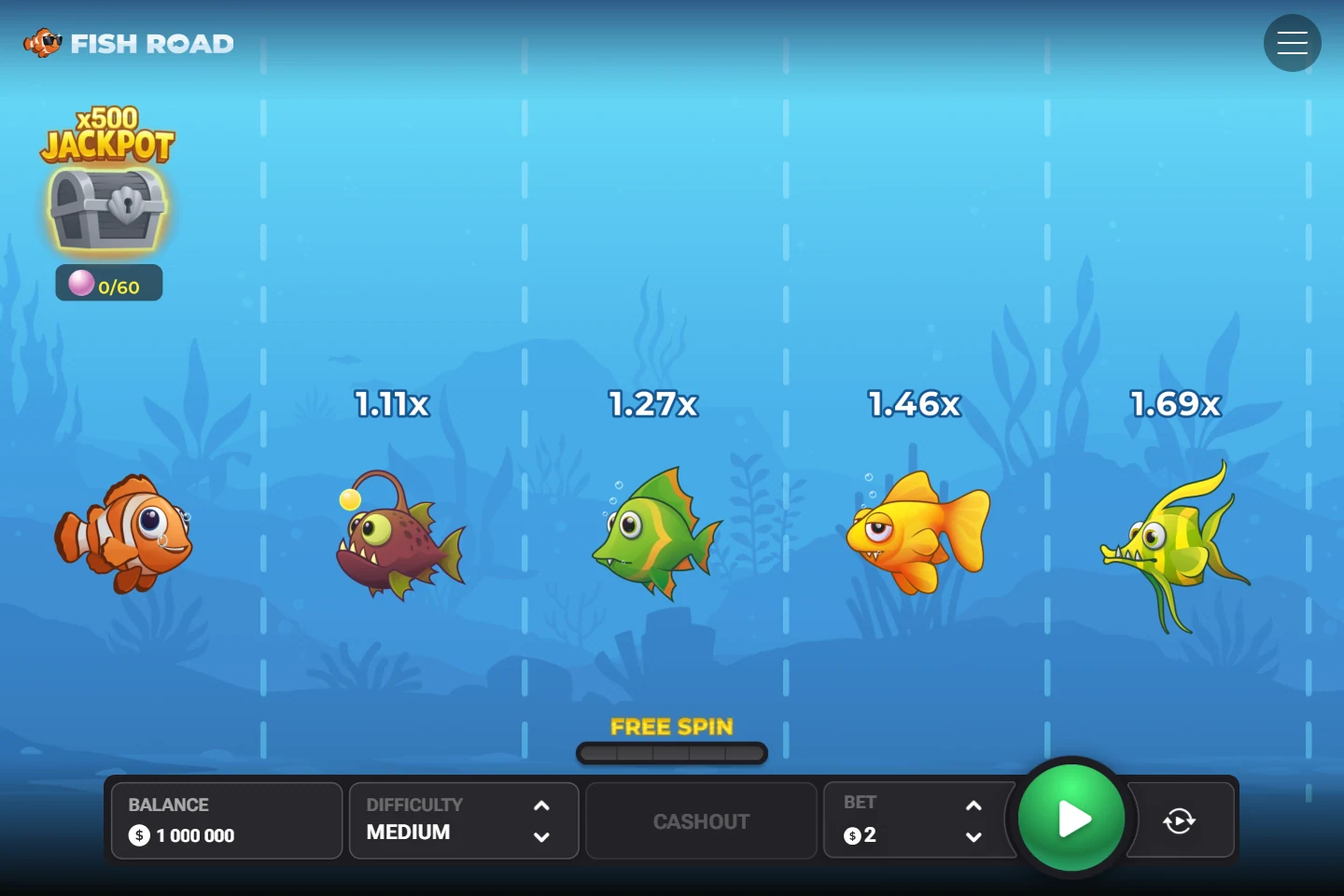
Our session opened with virtual USD credits. The displayed starting balance was 1,000,000 USD, which is deliberately far larger than a sensible personal entertainment budget. It is not money supplied for withdrawal. The large wallet lets you examine controls without making a deposit.
At the start of a 2 USD round, the client deducts 2 USD. It then performs the first step automatically. A successful first step on Medium gives a 1.11× offer; a collision can finish the attempt immediately. The first result is therefore already part of the paid round.
To reach the third successful step, the sequence is Play, then two more GO actions while the round remains active. Do not press GO twice after a loss and count that as continuing the same round. A newly accepted stake begins a new attempt and belongs on another line of a record.
Wait for the game’s visible state to settle before another action. A slow animation or a delayed response is not evidence that a tap went unnoticed. If a connection breaks, inspect the restored state and history rather than assigning a win or loss from a frozen frame.
What the cashout button actually pays
The amount on Cash Out is a total return. For the successful third-step round we observed, a 2 USD stake at 1.46× returned 2.92 USD. Net profit was 0.92 USD. The original 2 USD is included in the 2.92 and must not be added a second time.
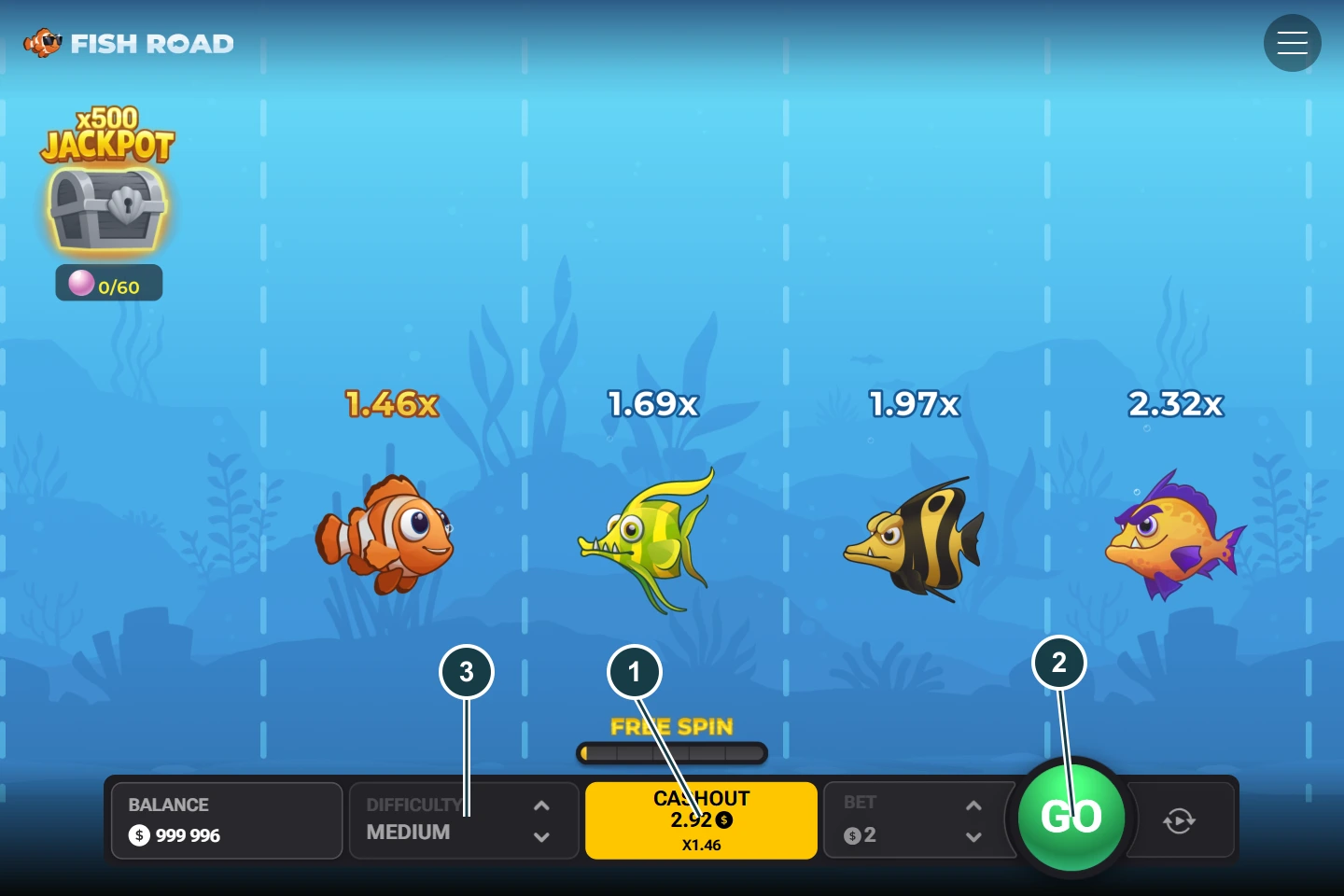
A simple wallet example makes the accounting clear. Start with 100 USD, pay a 2 USD stake and the balance becomes 98. A settled 2.92 USD return brings it to 100.92. If that round instead returns zero, the final wallet stays at 98. There is no extra stake deduction at the collision.
Continuing also has an opportunity cost. Once the game offers 2.92 USD, another GO risks losing the chance to collect that amount. This does not mean an additional 2.92 USD stake is charged. It means the existing round can end without returning the currently available amount.
The cashout decision tool compares these two choices with hypothetical numbers. It can calculate what success probability would make them equal in a simplified model. It does not know the real probability that Fish Road assigns to your next step.
A persistent LAST WIN display needs care. Our final recorded round lost, but the screen still showed 2.92 from the earlier winning round. Reading that label as the current result would turn a loss into a false win. Use the active offer and the completed history to identify the correct round.
Collecting in the game is also separate from withdrawing account funds. The word withdraw in a technical round message does not mean a bank transfer. Payments out of a commercial account follow the operator’s own identity and withdrawal process.
Try the comparison at two neighbouring positions
Medium’s second and third successful positions are 1.27× and 1.46×. On a 2 USD stake, those offers are 2.54 and 2.92 USD. Moving on seeks 0.38 USD more gross return while giving up the ability to collect 2.54 now.
In the stripped-down model, equality would require 2.54 divided by 2.92, or about 86.99% success for that single next step. This is not the 68.49% threshold for reaching 1.46× from the start of a new bet. One calculation begins with a stake already exposed; the other begins before paying it.
This difference is why the same word “probability” needs a clear starting point. A current-round decision, a fresh-round target and a long-run RTP are three distinct quantities. The game does not become predictable because all three can be written as percentages.
Difficulty, coefficients and the 20,000 USD cap
Swipe sideways to see every column.
| Difficulty | Positions | First step | Final coefficient |
|---|---|---|---|
| Easy | 24 | 1.02× | 25× |
| Medium | 22 | 1.11× | 2,500× |
| Hard | 20 | 1.22× | 52,067.39× |
| Very Hard | 15 | 1.63× | 2,542,251.93× |
The paths have 24 positions on Easy, 22 on Medium, 20 on Hard and 15 on Very Hard. A shorter path is not automatically easier to finish. A higher coefficient at an early position is not enough to compare value without knowing how often that position is reached.
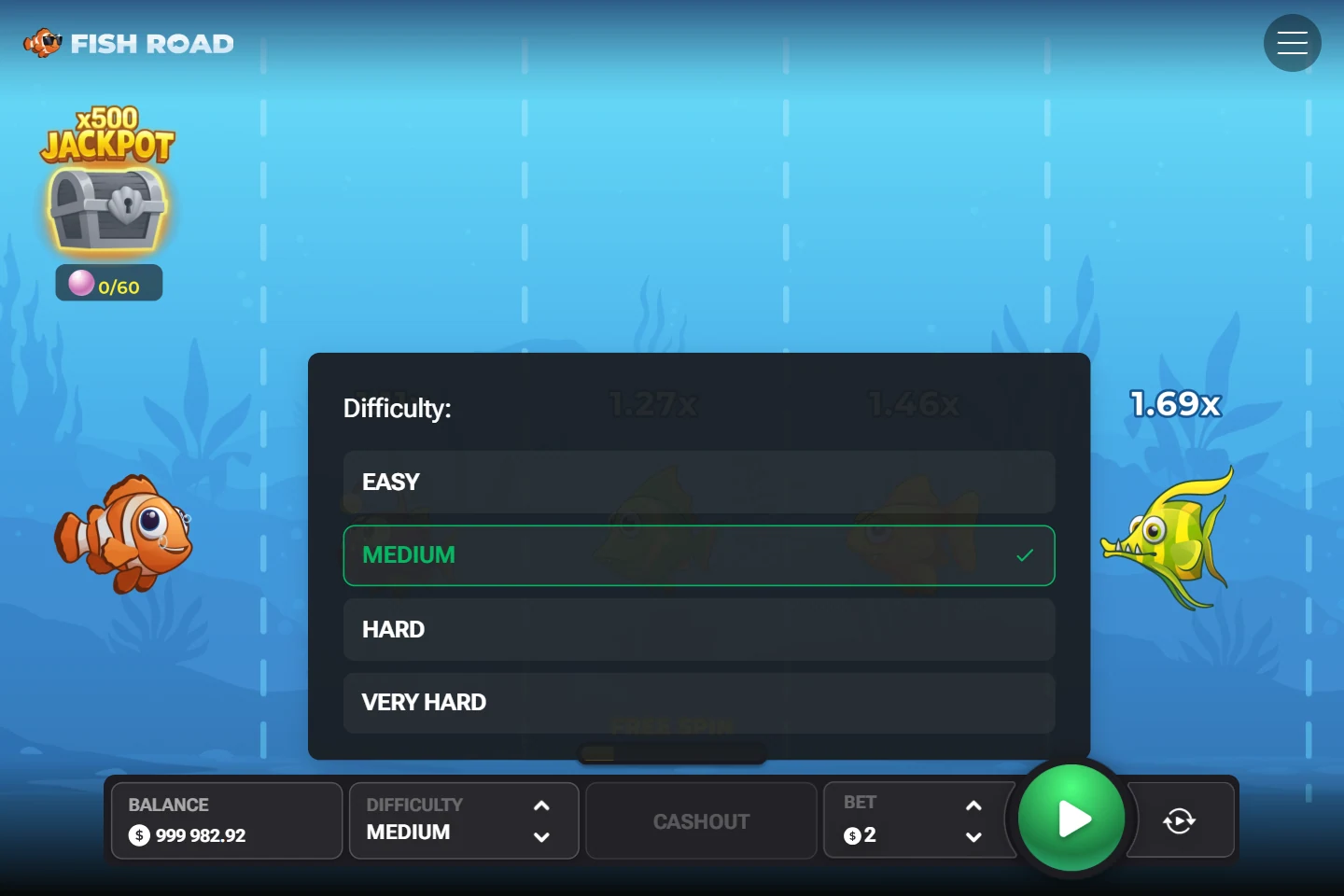
Medium begins with 1.11×, 1.27× and 1.46×. Those numbers describe the offers after successful steps one, two and three. They are not probabilities. In our sample, most starts ended before the third offer became available.
Easy’s final coefficient is 25× and Medium’s is 2,500×. Hard lists 52,067.39×, while Very Hard lists 2,542,251.93×. The last two cannot be interpreted as unrestricted money amounts because the inspected configuration also specifies a 20,000 USD maximum win.
At the minimum stake of 0.12 USD, multiplying by Very Hard’s final coefficient gives 305,070.2316 USD before the cap. The configured maximum remains 20,000 USD. We did not reach a final chest or observe a cap-sized settlement, so this is a limit comparison rather than a claimed payout.
The minimum and maximum stakes were 0.12 and 200 USD. Quick buttons offered 1, 2, 5 and 10. These are observed demo settings, not a confirmed list of euro stakes at every Greek-facing account. Check the currency and limits inside the client you actually open.
The provider states a 96% RTP. That is not a 96% chance of surviving a step, winning a round or finishing with a profit. It is a theoretical return figure. Do not insert it into a next-step calculation as though it were the missing survival probability.
Two progress meters, different meanings
The pearl counter has a target of 60. The help describes a shell that can appear during an ordinary round and contribute a pearl. The jackpot labels are Mini, Major and Mega, with displayed multipliers of 5×, 25× and 500×.
No pearl was collected in our ten-round Medium session, and no jackpot was completed. The threshold and jackpot labels come from the game interface and help. They are not a measured frequency or a bonus payment in our round table.
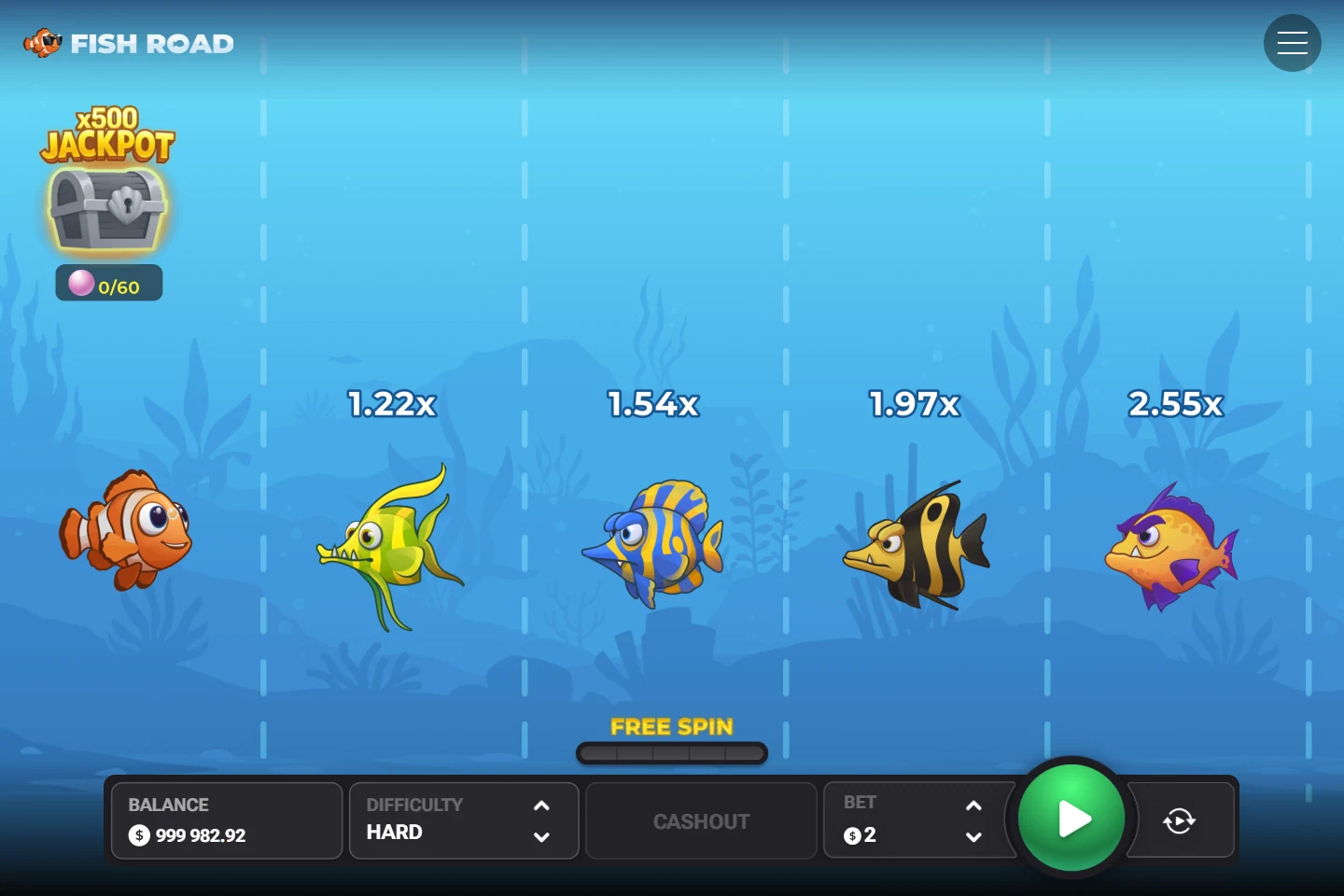
The free-spin progress bar is a separate feature. The help links completed progress to a roulette selection. The client draws this meter against a score of 300, but a score point has not been established here as one spin, one euro or one pearl. A numeric drawing threshold is not a verified cost to earn free spins.
Progress is keyed to the combination of stake, currency and difficulty. Switching one of them can show another bucket. It is therefore unsafe to assume that a partly filled meter at a previous stake will remain the active meter after increasing the bet.
The help describes retaining progress for 30 calendar days. We did not leave an account idle for thirty days to test that statement. It should be read as a displayed rule, with the implementation and account context still worth checking.
A feature that has not finished is not a settled bonus win. Keep the visible meter separate from the amount returned to the wallet. A game can show attractive progress while the ordinary rounds in the same session have a negative net result.
Do not treat a nearly filled bar as proof that a larger stake is justified. You would need the future cost and outcome distribution of completing it to make that comparison. Our short session does not supply either quantity.
Autoplay and the mobile view
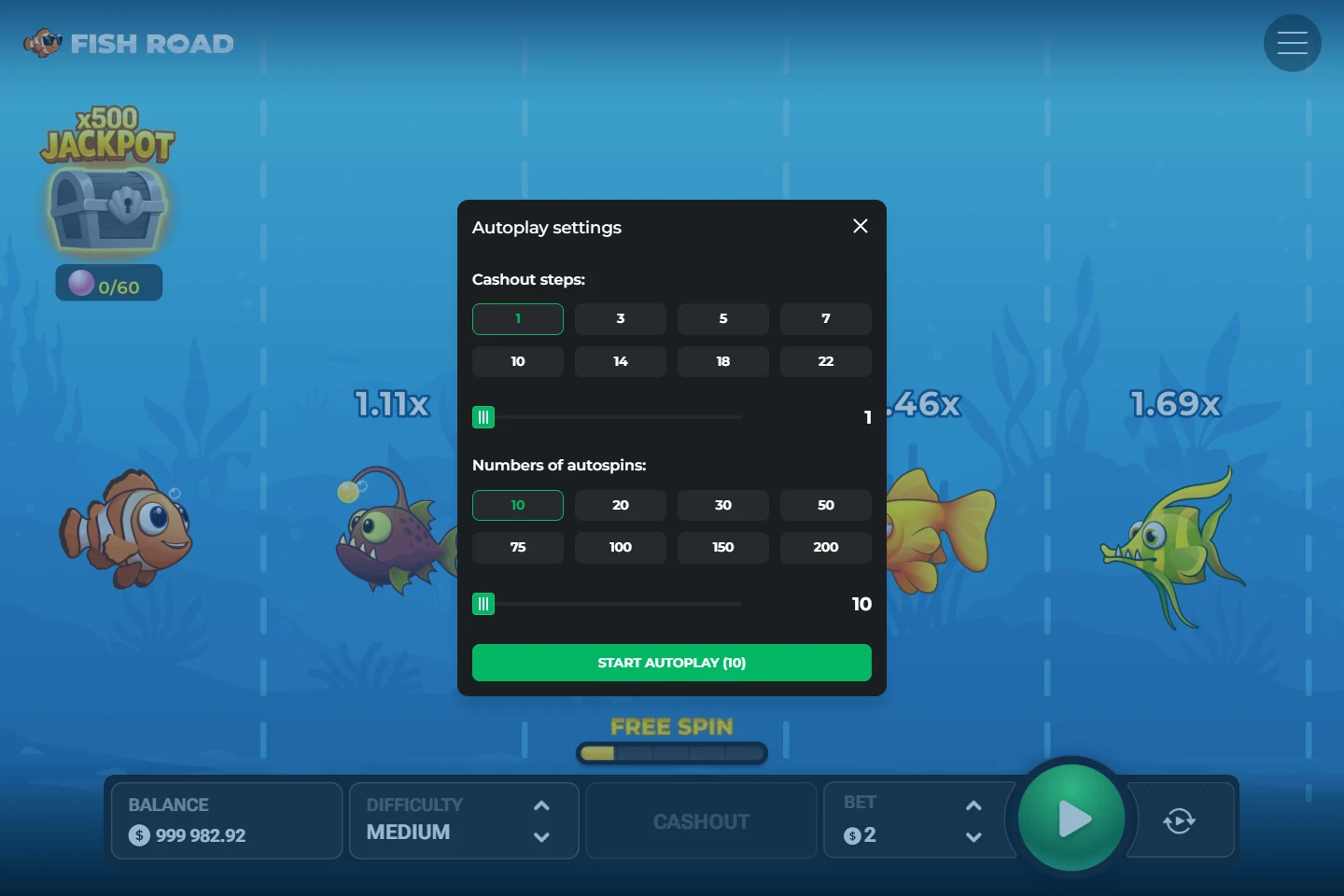
The menu offered batches of 10, 20, 30, 50, 75, 100, 150 and 200 rounds, plus a cashout-step setting. Available target steps depend on the selected difficulty. Choosing a round count does not guarantee that every round will reach its exit.
At a 2 USD stake, selecting 50 new rounds plans 100 USD of initial stakes over that batch. Returns may fund later starts, but they do not remove the need to choose an exposure limit before enabling automatic play. Total stakes and net loss are different measurements.
We did not identify a verified turbo control that changes the payout model. Faster clicking is a timing preference, not a demonstrated strategy. If a page or device struggles, avoid opening several simultaneous demos merely to increase the pace.
Our embedded frame is unloaded until you choose to start it. On a phone, give the board enough vertical space to keep the bottom controls visible. Full screen may help where supported; landscape or the provider page is the fallback. No separate installation is needed for the ordinary public browser demo.
A narrow-browser screenshot checks layout, not every physical Android or iPhone. We did not measure Greek mobile-network speed. The technical timing below is from the recording connection and should not be sold as a country-wide performance benchmark.
The technical route from a button to a result
The client communicated through Socket.IO over WebSocket. The observed gameplay actions were bet for the paid start, step for movement and withdraw for an in-game cashout. We inspected the ordinary client’s traffic; this guide does not send those commands on a reader’s behalf.
The ten-round sequence contained ten bet pairs, twenty-one step pairs and one cashout pair. There are more step messages than paid starts because a surviving round can advance several times. There is only one cashout because only one attempt reached our third-step target.
For those 32 gameplay request-and-acknowledgement pairs, the captured interval was approximately 68–476 milliseconds. It includes network travel, server handling and local capture timing. It is not one-way latency or an independently isolated server-processing measurement.
Configuration and history traffic is separate from paid gameplay. Counting every message as a round would exaggerate the sample. Our published CSV contains ten settled paid attempts, including all nine losses, and no replacement entries selected for better-looking outcomes.
The client includes a fairness screen with seed and hash fields. We did not independently validate the complete algorithm or reproduce its distribution. The interface’s presence is not a licence to advertise a working predictor. No verified pre-result signal was established by this inspection.
Use technical observations to understand the client’s states and to avoid double-counting. They do not turn a short demo sample into a certificate for future outcomes. For what the actual ten attempts show, continue to the strategy study.
A useful technical check has a clear boundary
A command acknowledgement tells us which response belongs to an action. It does not independently prove the random generator is fair. Likewise, a seed or hash field is material for a verification procedure, not the completed procedure itself. Our inspection established the message flow, not an independently reproduced cryptographic proof.
For an interrupted attempt, the important question is whether the ordinary client later reports a settled state. Until then, keep the attempt outside a completed-results subtotal and mark it unresolved. Counting it as a loss or silently dropping it would each add an assumption the capture did not establish.
Fish Road Free Spins: what the Bet Bar actually unlocks
Watch the Bet Bar rather than the pearl counter when looking for Fish Road free spins. The help says that a full Bet Bar opens a roulette award of Free Spins. The pearl collection has a different purpose: its 60-item target belongs to the jackpot feature.
There are three stages to distinguish: filling the bar with paid play, seeing what the roulette awards, and settling the awarded spins. Finishing the first stage does not tell you the return from the last. A wheel animation is not a separate cash withdrawal.
For our Medium sample, the sequence ended after ten settled rounds without a completed free-spin award. We therefore have no observed number of spins needed to fill the bar, no full feature cost and no final free-spin payout. The client’s 300-point drawing scale cannot supply those missing figures.
Progress depends on the stake, currency and difficulty combination. Record that combination before leaving the game or changing a setting. A switch can display a different meter; a partial bar is not a reason to increase the next stake. If you later complete the feature, keep all earlier paid starts in the cost calculation, not just the awarded spins.
Questions players ask
Is Very Hard a separate Fish Road game?
No. VERY HARD, Hardcore and the internal DAREDEVIL label refer to the fourth difficulty in the inspected game.
Did the ten-round test trigger a jackpot?
No. The Medium session collected no pearl and completed no jackpot or free-spin feature.
Does the demo need an APK?
The ordinary public demo opens in the browser. This guide does not provide an APK or a predictor download.